- English
- French
- German
- Portuguese
- Spanish
- Russian
- Japanese
- Korean
- Arabic
- Greek
- German
- Turkish
- Italian
- Danish
- Romanian
- Indonesian
- Czech
- Afrikaans
- Swedish
- Polish
- Basque
- Catalan
- Esperanto
- Hindi
- Lao
- Albanian
- Amharic
- Armenian
- Azerbaijani
- Belarusian
- Bengali
- Bosnian
- Bulgarian
- Cebuano
- Chichewa
- Corsican
- Croatian
- Dutch
- Estonian
- Filipino
- Finnish
- Frisian
- Galician
- Georgian
- Gujarati
- Haitian
- Hausa
- Hawaiian
- Hebrew
- Hmong
- Hungarian
- Icelandic
- Igbo
- Javanese
- Kannada
- Kazakh
- Khmer
- Kurdish
- Kyrgyz
- Latin
- Latvian
- Lithuanian
- Luxembou..
- Macedonian
- Malagasy
- Malay
- Malayalam
- Maltese
- Maori
- Marathi
- Mongolian
- Burmese
- Nepali
- Norwegian
- Pashto
- Persian
- Punjabi
- Serbian
- Sesotho
- Sinhala
- Slovak
- Slovenian
- Somali
- Samoan
- Scots Gaelic
- Shona
- Sindhi
- Sundanese
- Swahili
- Tajik
- Tamil
- Telugu
- Thai
- Ukrainian
- Urdu
- Uzbek
- Vietnamese
- Welsh
- Xhosa
- Yiddish
- Yoruba
- Zulu
ASTM B564 Inconel 625 Forging
Manufacturing Capacity: 150 tons/month
Grade: Inconel 625 (UNS N06625)
Standard: ASTM B564, ASTM B446, JIS, DIN
Size: Custom sizes available
Finish: Polished, Annealed
Material Certification: MTC and SGS test reports available
Customized Size and Processing: Supported
Certificate: ISO9001:2008, TÜV, MTC acc EN10204.3.1
Delivery: 20-45 days
ASTM B564 Inconel 625 Forging – High-Performance Nickel Alloy Components
When you confront extraordinary erosion, high-temperature oxidation, or forceful chemical situations, ASTM B564 Inconel 625 forging conveys the unwavering quality you require. This nickel-chromium-molybdenum amalgam component is fabricated through controlled thermo-mechanical misshapening agreeing to ASTM B564 guidelines. The producing handle refines grain structure and upgrades mechanical judgment distant past cast or machined choices. Whether you're overseeing acrid gas wells, aviation warm cycling, or seawater presentation, these forgings unravel your hardest designing challenges with demonstrated execution from cryogenic temperatures to 1800°F.

What is ASTM B564 Inconel 625 Forging?
These are precision-engineered components made from Inconel 625 (UNS N06625) through hot or cold forming. The controlled distortion adjusts the grain stream with portion geometry, making directional quality that maximizes weakness resistance and affects sturdiness. You get predominant mechanical properties compared to standard bar stock, making them perfect for basic applications in oil & gas, aviation, and chemical processing industries.
Specification
| Parameter | Details |
|---|---|
| Grade | Inconel 625 (UNS N06625) |
| Standard | ASTM B564, ASTM B446, ASME SB564 |
| Size Range | Custom sizes available |
| Form | Flanges, rings, discs, blocks, shafts |
| Surface Finish | Polished, annealed, as-forged |
| Manufacturing Capacity | 150 tons/month |
| Delivery Time | 5–20 days |
| Certification | ISO9001:2008, TÜV, AS9100D, MTC acc EN10204.3.1 |
Physical and Chemical Properties
Chemical Composition
| Element | Composition (%) |
|---|---|
| Nickel (Ni) | Min 58.0 |
| Chromium (Cr) | 20.0–23.0 |
| Molybdenum (Mo) | 8.0–10.0 |
| Niobium + Tantalum (Nb+Ta) | 3.15–4.15 |
| Iron (Fe) | Max 5.0 |
| Carbon (C) | Max 0.10 |
Mechanical Properties
| Property | Value |
|---|---|
| Tensile Strength | Min 120 ksi (827 MPa) |
| Yield Strength (0.2% offset) | Min 60 ksi (414 MPa) |
| Elongation | Min 30% |
| Hardness | 95 HRB typical |
| Temperature Range | Cryogenic to 982°C (1800°F) |
Product Standards
Our ASTM B564 Inconel 625 forging complies with:
- ASTM B564 / ASME SB564
- ASTM B446
- NACE MR0175 / ISO 15156 (for acrid service)
- JIS, Commotion, EN standards
- AS9100D (aviation applications)
Production and Processing Technology
Our 50,000㎡ modern manufacturing facility is equipped with over 100 precision machines, including advanced forging presses up to 3,000 tons, multiple heat treatment furnaces with precise temperature control, and CNC machining centers to ensure tight tolerances and superior surface finishes. Supported by comprehensive in-house testing laboratories and ISO-certified quality management systems, we deliver consistent, high-quality products. Additionally, our solid-solution strengthening technology provides excellent fabricability without the brittleness typically associated with precipitation-hardened alloys, enabling the production of complex geometries with confidence.
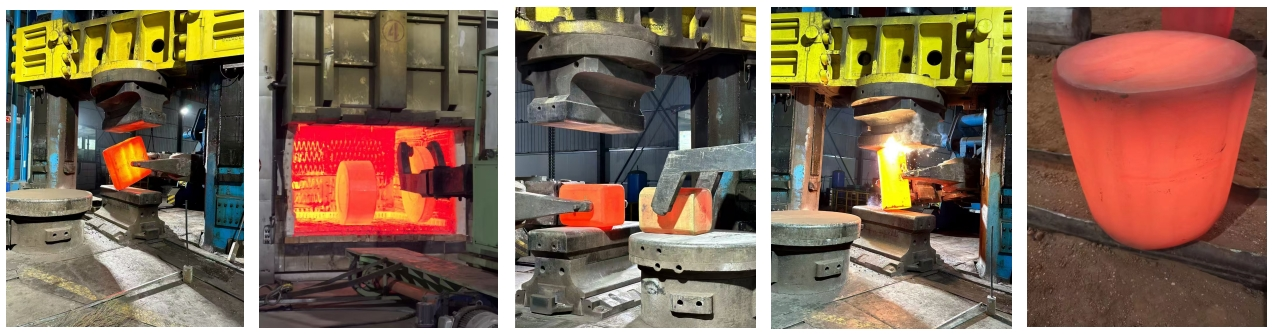
Quality Inspection
Every component experiences thorough testing:
Dimensional Inspection: CMM and precision measuring instruments
Ultrasonic Testing (UT): Detects internal discontinuities
Radiographic Testing (RT): Ensures structural integrity
Eddy Current Testing (ECT): Identifies surface defects
Hydrostatic Testing: Validates pressure ratings
Chemical Analysis: Verifies composition compliance
Mechanical Testing: Tensile, hardness, and impact tests
You get total documentation counting MTC, test reports (SGS available), and QAC/ITP/MTR certificates.
What are the Features of the product?
✔ Remarkable Erosion Resistance: Tall resistance to setting, hole erosion, and push erosion breaking (PREN > 45)
✔Predominant High-Temperature Quality: Keeps up basic keenness up to 982°C without precipitation hardening
✔Fabulous Weldability: Can be joined to divergent metals without post-weld warm treatment
✔ Upgraded Weakness Resistance: Directional grain stream from producing increments cycle life
✔ Oxidation & Scaling Resistance: Performs dependably in both oxidizing and diminishing atmospheres
✔ Acrid Gas Compatibility: Completely compliant with NACE measures for H2S environments
Application
Oil & Gas Industry
You can depend on these forgings for subsea wellhead components, valve bodies, Christmas tree parts, and downhole holders. They stand up to H2S, CO2, and basic sulfur in acrid benefit conditions.
Aerospace & Defense
Critical motor components, pushed reverser congregations, debilitate frameworks, and fuel line spines advantage from fast warm cycling resistance.
Marine & Chemical Processing
Seawater channeling frameworks, brine concentrators, response vessels, and warm exchangers in phosphoric corrosive generation situations request this level of erosion protection.
Power Generation
Steam turbine parts, gas turbine components, and atomic reactor internals require the combination of tall quality and oxidation resistance.
Why Choose TSM Technology?
14+ A long time of Worldwide Involvement: We've provided clients in 70+ nations with demonstrated reliability.
AS9100D Certified: Aerospace-grade quality measures for your most requesting applications.
Full-Process Fabricating: From softening to last assessment beneath one roof guarantees quality control.
Fast Reaction & Specialized Back: Our building group gives discussion all through your project.
Customization Capability: Whether standard or complex geometries, we provide absolutely what you need.
Proven Fabric Execution: Our combinations work dependably in the harshest situations worldwide.
Package and Shipping
We secure your speculation with proficient packaging:
- Wooden cases for overwhelming forgings
- Plastic caps and conclusion protectors
- Rust avoidance treatment
- Custom crating for complex geometries
- Clear labeling with warm numbers and specifications
Our Hong Kong coordination center guarantees prompt worldwide conveyance with full documentation for customs clearance.

FAQ
Q1: What is the difference between Grade 1 and Grade 2 product?
A: Review 1 is tempered at roughly 1600°F for ideal properties at direct temperatures. Review 2 experiences arrangement strengthening at around 2000°F, giving most extreme crawl resistance over 1100°F.
Q2: Can these forgings be welded to other alloys?
A: Yes, they display fabulous weldability. You can connect them to disparate metals like carbon steel utilizing ERNiCrMo-3 filler without post-weld heat treatment in most cases.
Q3: Why choose forging over standard bar stock?
A: The producing handle makes grain stream that matches your portion geometry, resulting in essentially higher weakness life and superior resistance to high-pressure warm cycles.
Q4: Are these forgings suitable for sour service environments?
A: Completely. They completely comply with NACE MR0175/ISO 15156 guidelines for H2S-containing situations, making them perfect for acrid gas applications.
Q5: What is the maximum service temperature?
A: Whereas keeping up oxidation resistance up to 1800°F (982°C), pressure-rating codes regularly restrain auxiliary channeling applications to 1200°F–1500°F depending on particular ASME code requirements.
Q6: Do you provide material test reports?
A: Yes, every shipment includes Material Test Certificates (MTC) according to EN10204.3.1, and SGS test reports are available upon request.
Contact Us
Ready to discuss your specific requirements for ASTM B564 Inconel 625 forging? Our technical team is here to help you select the right solution.
📧 Email: info@tsmnialloy.com
Online Message
Learn about our latest products and discounts through SMS or email
Learn about our latest products and discounts through SMS or email