- English
- French
- German
- Portuguese
- Spanish
- Russian
- Japanese
- Korean
- Arabic
- Greek
- German
- Turkish
- Italian
- Danish
- Romanian
- Indonesian
- Czech
- Afrikaans
- Swedish
- Polish
- Basque
- Catalan
- Esperanto
- Hindi
- Lao
- Albanian
- Amharic
- Armenian
- Azerbaijani
- Belarusian
- Bengali
- Bosnian
- Bulgarian
- Cebuano
- Chichewa
- Corsican
- Croatian
- Dutch
- Estonian
- Filipino
- Finnish
- Frisian
- Galician
- Georgian
- Gujarati
- Haitian
- Hausa
- Hawaiian
- Hebrew
- Hmong
- Hungarian
- Icelandic
- Igbo
- Javanese
- Kannada
- Kazakh
- Khmer
- Kurdish
- Kyrgyz
- Latin
- Latvian
- Lithuanian
- Luxembou..
- Macedonian
- Malagasy
- Malay
- Malayalam
- Maltese
- Maori
- Marathi
- Mongolian
- Burmese
- Nepali
- Norwegian
- Pashto
- Persian
- Punjabi
- Serbian
- Sesotho
- Sinhala
- Slovak
- Slovenian
- Somali
- Samoan
- Scots Gaelic
- Shona
- Sindhi
- Sundanese
- Swahili
- Tajik
- Tamil
- Telugu
- Thai
- Ukrainian
- Urdu
- Uzbek
- Vietnamese
- Welsh
- Xhosa
- Yiddish
- Yoruba
- Zulu
Aerospace Fasteners: Why Nickel Alloys are used in Jet Engines
Engineers have to choose between standard fastening solutions and specialized metals when choosing materials for jet engine parts. Which one they choose can mean the difference between routine success and catastrophic failure. Nickel fasteners have changed the way aircraft is made because they work so well in harsh conditions where temperatures can reach over 1,000°F and corrosive surroundings make it hard for regular materials to do their job. These high-tech fastening options provide the dependability, sturdiness, and safety margins that modern aircraft needs. This makes them essential for important jet engine uses.
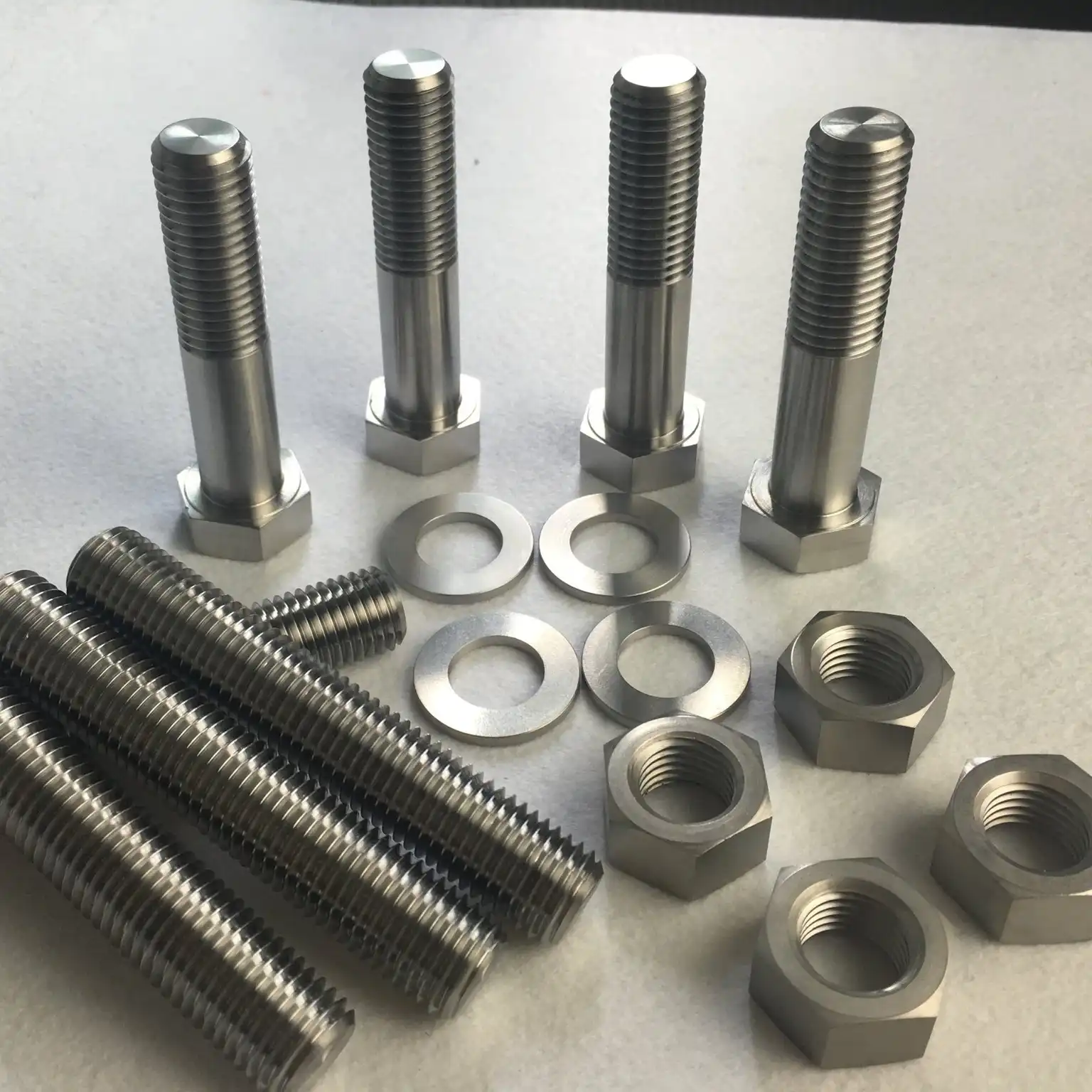
Understanding Nickel Alloy Fasteners in Aerospace
Engineers in the aerospace industry have found that nickel-based alloy rivets are much better than standard materials. Nickel is the main element in these specialized parts. It is mixed with carefully chosen metals like chromium, molybdenum, and titanium to make superalloys that have amazing properties.
Nickel alloy screws are made with exact chemical combinations that make microstructures that are one of a kind. When it comes to aircraft uses, Inconel, Monel, Incoloy, and Hastelloy are the most popular alloy types. Each mixture is designed to achieve certain performance traits that are necessary for jet engine conditions.
Inconel 718, which is made up of about 50–55% nickel, keeps its strength very well at temperatures up to 1,300°F. Adding niobium and molybdenum makes structures that are hardened by precipitation and keep their mechanical properties even when the temperature changes a lot. Because of this level of metalworking skill, fasteners can survive the harsh conditions in turbine areas.
Manufacturing aerospace fasteners, including nickel fasteners, follows strict rules that make sure quality is always the same and that parts can be tracked. Certified raw materials that meet ASTM, DIN, JIS, BS, and GB/T norms are the first step in the production process. Modern melting methods, like vacuum induction melting and electroslag remelting, get rid of elements that could hurt performance.
Every step of the manufacturing process is checked for quality, and each part is put through measurement checking, mechanical testing, and chemical analysis. Certifications according to EN10204 3.1/3.2 are written proof of material compliance, and inspection records from a third party provide extra proof for important uses.
Different types of nickel metal fasteners are used in aerospace uses. Each type is designed to meet specific mounting needs. Bolts, screws, nuts, washers, and rivets can be made with very tight standards on sizes from M2.5 to M32 widths. Custom sizes can also be made for specific uses. The length standards range from 1 mm to 1990 mm to meet a wide range of building needs.
Advantages of Nickel Alloy Fasteners in Jet Engine Environments
Because jet engines have to work in very specific conditions, screws are often exposed to very high temperatures, corrosive burning fumes, and a lot of mechanical stress. When you know how nickel metals deal with these problems, you can see why they are the best material for important tasks.
It is possible for jet engines to work at temperatures that would melt most types of fasteners. The combustion chamber and turbine parts are hotter than 2,000°F, and the fast changes in temperature during takeoff and landing add to the stress. Because of the way their crystals are structured and the elements that are mixed in, nickel alloys keep their tensile traits at high temperatures.
Nickel's face-centered cubic crystal structure makes it naturally stable at high temperatures. Elements like aluminum and titanium form protective oxide layers that stop the metal from oxidizing even more. This mixture makes it possible for nickel fasteners to work consistently in temperature ranges where steel fasteners would weaken or rust badly.
Corrosive conditions affect airplane engines from many places, such as combustion fumes, atmospheric moisture, salt contact during seaside operations, and nickel fasteners. Because nickel metals contain chromium, it makes strong oxide films that stop corrosion from starting and spreading.
Marine environments are especially hard for aerospace operations, especially for military planes and sites near the coast. Nickel metals are very good at resisting stress corrosion cracking caused by chloride, a type of failure that can make fasteners less reliable in salty environments. This resistance means that the equipment will last longer between services and cost less to maintain.
Nickel alloy screws have better mechanical qualities than regular materials at all temperatures where they are used. Even at high temperatures, when most materials lose a lot of their properties, these metals keep their high tensile strength, yield strength, and impact toughness.
Another important benefit is that it doesn't wear out easily, since jet engine bolts go through millions of stress cycles during normal operation. Nickel metals' microstructural stability stops cracks from starting and spreading during cyclic loading. This helps parts last longer and have wider safety gaps.
Comparative Analysis to Guide Purchase Decisions
When selecting fasteners for aircraft uses, engineering teams have to look at more than one type of material. When compared to other materials, this study shows that nickel metals have better performance and are a better deal.
Several performance measures make it clear that nickel metals are better than stainless steel, titanium, and regular steel fasteners. When heated above 800°F, temperatures where stainless steel weakens a lot happen, but nickel metals stay strong. Titanium has a great strength-to-weight ratio, but nickel metals are better at resisting rust and staying stable at high temperatures.
The comparison shows that nickel screws regularly do better than other options in a number of important ways. In harsh settings, it has better corrosion resistance than stainless steel. In acidic environments, it has better temperature resistance than titanium. These improvements in speed mean that the service will last longer and cost less to own overall.
Nickel metal fasteners, Nickel fasteners are more expensive than fasteners made of other materials, but their better performance saves a lot of money over the span of the part. Longer service intervals lower the cost of maintenance work, and better efficiency cuts down on unplanned downtime and the money lost because of it.
The total cost equation needs to take into account not only the original cost of the materials, but also the labor costs for installation, the regularity of upkeep, and the availability of replacement parts. When looked at over the usual 10–20-year service intervals in aircraft, nickel fasteners often offer better economic value, even though they cost more up front.
To choose the right fasteners, you need to make sure that the qualities of the materials you use match the needs of the purpose. In high-temperature turbine applications, the highest temperature capability is needed. In structure uses, on the other hand, strength-to-weight ratios may be more important. In corrosive environments, better chemical resistance is needed, and for important safety uses, proven dependability and a lot of certification paperwork are needed.
Best Practices for Sourcing and Procuring Nickel Alloy Fasteners
When procurement workers try to find aerospace-grade nickel screws, they have to deal with special problems, such as finding qualified suppliers, making sure the materials are correct, and making sure deliveries happen on time. Using tried-and-true buying methods makes sure that you can get high-quality goods while also lowering costs and improving delivery times.
To choose reliable providers, you need to look closely at their manufacturing skills, quality control systems, and certification status. Leading providers keep aircraft licenses like AS9100, NADCAP, and different OEM approvals that show they follow industry standards.
With three factories, eight production lines, and more than 70 specialized tools, TSM Technology is a great example of the skills needed to offer aerospace fasteners. This infrastructure can handle production rates running from 100,000 to 300,000 pieces, so it can handle both small batches of prototypes and full production runs.
Complete material traceability is needed for aerospace uses, from certifying the raw materials to the final review. Suppliers who are qualified offer complete paperwork packages that include approvals for the materials, records on dimensional inspections, mechanical test results, and Nickel fasteners. Manufacturers of aerospace parts can keep the detailed records needed for airworthiness approval with these papers.
For important uses, third-party testing services offer extra proof of material qualities and dimensional compliance from a third party. This extra supervision helps buying teams meet strict quality standards and show regulatory authorities that they did their job properly.
Due to the tight plans for aerospace production, deliveries must be reliable and buying must be flexible. Leading suppliers offer delivery times between 10 and 25 days, based on the amount and customization needs. For urgent uses, there are also choices for faster delivery. Most of the time, the minimum order quantity is 100 pieces, which works for both production needs and research projects.
Carrying costs and stock-out risks need to be balanced in good inventory management. This is especially important for aircraft screws because they are so specialized. Just-in-time delivery is possible thanks to strategic partnerships with qualified providers, and extra stock is kept on hand in case of sudden needs.
Future Trends and Innovations in Aerospace Nickel Fasteners
As performance standards in the aerospace business keep getting higher, new materials, manufacturing methods, and quality assurance technologies are needed to keep up. Knowing about these trends helps people who work in buying make smart choices about how to work with suppliers and what materials to use.
Through complex alloying schemes and processing methods, materials science keeps pushing the limits of how well nickel-based superalloys work. The goal of new compositions is to make certain gains in temperature resistance, resistance to corrosion, or ease of manufacturing. These new developments look like they will improve performance for next-generation aircraft uses.
Powder metallurgy techniques allow for exact control of makeup and better material qualities than traditional melting methods. With additive manufacturing, you can make complicated shapes and fastener designs that work together to get the best weight and performance. In the next ten years, these technology breakthroughs will change how fasteners are designed and made.
Industry 4.0 technologies are changing the way aircraft is made by automating more, watching processes in real time, and collecting a lot of data. Smart manufacturing systems make it possible to precisely control the Nickel fasteners production process and keep accurate Nickel fasteners quality records that meet the needs for tracking.
Better quality control is possible with digital inspection technologies like non-destructive testing and automatic measuring of dimensions. These systems find flaws and differences that a person looking at the product by hand might miss. This makes the product more reliable and lowers the cost of the guarantee.
Blockchain technology makes the supply chain more open than ever before by keeping permanent records of where materials came from, how they were processed, and how well they were made. This feature meets the needs of more and more regulations that want to see what's going on in the supply chain and helps with environmental efforts.
Environmental concerns are becoming more and more important in choosing materials and evaluating suppliers. Suppliers who show they are committed to sustainable manufacturing practices, such as using less energy and less trash, have an edge when it comes to buying choices.
Conclusion
When standard materials can't meet the performance needs of difficult aircraft uses, nickel alloy fasteners are the best choice. Nickel fasteners' ability to withstand high temperatures, resistance to corrosion, and mechanical qualities make them effective in the harsh environments found in jet engine uses. However, nickel alloys have a higher starting cost than regular fasteners, but they have a lower total cost of ownership because they last longer and need less upkeep. To make sure projects are good, procurement workers must work with qualified suppliers who can show they can do great manufacturing, quality assurance, and reliable delivery.
FAQ
1. Why are nickel fasteners superior to stainless steel in aerospace applications?
Nickel metals keep their mechanical strength and ability to fight corrosion at temperatures where stainless steel weakens a lot. Nickel-based superalloys are needed in hot parts of jet engines because stainless steel would not hold up against rust and is not as stable at high temperatures.
2. What is the difference between nickel-plated and solid nickel fasteners?
When it comes to performance and dependability, solid nickel screws are better than nickel-plated ones. Plated screws help protect against corrosion in some ways, but the plating can wear off or chip during placement, showing the base material. The qualities of solid nickel alloy rivets stay the same across their entire cross-section, so they work reliably even in harsh circumstances.
3. How can buying teams make sure that aerospace-grade fasteners are real?
Real aerospace fasteners come with full paperwork sets that include test results, material certifications, and records of how the fasteners were made. Suppliers who are qualified offer EN10204 3.1/3.2 licenses and inspection records from a third party. Markings and packaging should also match what the maker wants, and providers should keep up with the right aircraft certifications.
Partner with TSM Technology for Premium Aerospace Fastener Solutions
TSM Technology makes high-quality nickel fastener solutions that are designed to work perfectly in aircraft uses that demand the highest quality and performance. We have been making superalloys for more than 14 years and have three state-of-the-art buildings with eight dedicated production lines and more than 70 precision tools. Our aerospace-grade screws are made to strict ASTM, DIN, JIS, BS, and GB/T standards, and you can choose from sizes M2.5 to M32 and lengths up to 1990mm. As a reliable company that makes nickel fasteners, we offer full certification paperwork, such as EN10204 3.1/3.2 reports and third-party inspection confirmation, to make sure that all of our products can be tracked and meet aircraft standards. Email our expert team at info@tsmnialloy.com to talk about your unique fastener needs and to get free samples to try out.
References
1. Davis, J.R. "Nickel, Cobalt, and Their Alloys." ASM International Handbook Committee, Materials Park, OH, 2000.
2. Reed, R.C. "The Superalloys: Fundamentals and Applications." Cambridge University Press, Cambridge, UK, 2006.
3. Donachie, M.J. and Donachie, S.J. "Superalloys: A Technical Guide, 2nd Edition." ASM International, Materials Park, OH, 2002.
4. Bradley, E.F. "Superalloys: A Technical Guide." ASM International, Materials Park, OH, 1988.
5. Campbell, F.C. "Manufacturing Technology for Aerospace Structural Materials." Elsevier Science, Oxford, UK, 2006.
6. Aerospace Industries Association. "Aerospace Fastener Standards and Specifications Manual." AIA Publication, Washington, DC, 2019.
Learn about our latest products and discounts through SMS or email