- English
- French
- German
- Portuguese
- Spanish
- Russian
- Japanese
- Korean
- Arabic
- Greek
- German
- Turkish
- Italian
- Danish
- Romanian
- Indonesian
- Czech
- Afrikaans
- Swedish
- Polish
- Basque
- Catalan
- Esperanto
- Hindi
- Lao
- Albanian
- Amharic
- Armenian
- Azerbaijani
- Belarusian
- Bengali
- Bosnian
- Bulgarian
- Cebuano
- Chichewa
- Corsican
- Croatian
- Dutch
- Estonian
- Filipino
- Finnish
- Frisian
- Galician
- Georgian
- Gujarati
- Haitian
- Hausa
- Hawaiian
- Hebrew
- Hmong
- Hungarian
- Icelandic
- Igbo
- Javanese
- Kannada
- Kazakh
- Khmer
- Kurdish
- Kyrgyz
- Latin
- Latvian
- Lithuanian
- Luxembou..
- Macedonian
- Malagasy
- Malay
- Malayalam
- Maltese
- Maori
- Marathi
- Mongolian
- Burmese
- Nepali
- Norwegian
- Pashto
- Persian
- Punjabi
- Serbian
- Sesotho
- Sinhala
- Slovak
- Slovenian
- Somali
- Samoan
- Scots Gaelic
- Shona
- Sindhi
- Sundanese
- Swahili
- Tajik
- Tamil
- Telugu
- Thai
- Ukrainian
- Urdu
- Uzbek
- Vietnamese
- Welsh
- Xhosa
- Yiddish
- Yoruba
- Zulu
How Nickel Alloy Capillary Tubes Are Manufactured
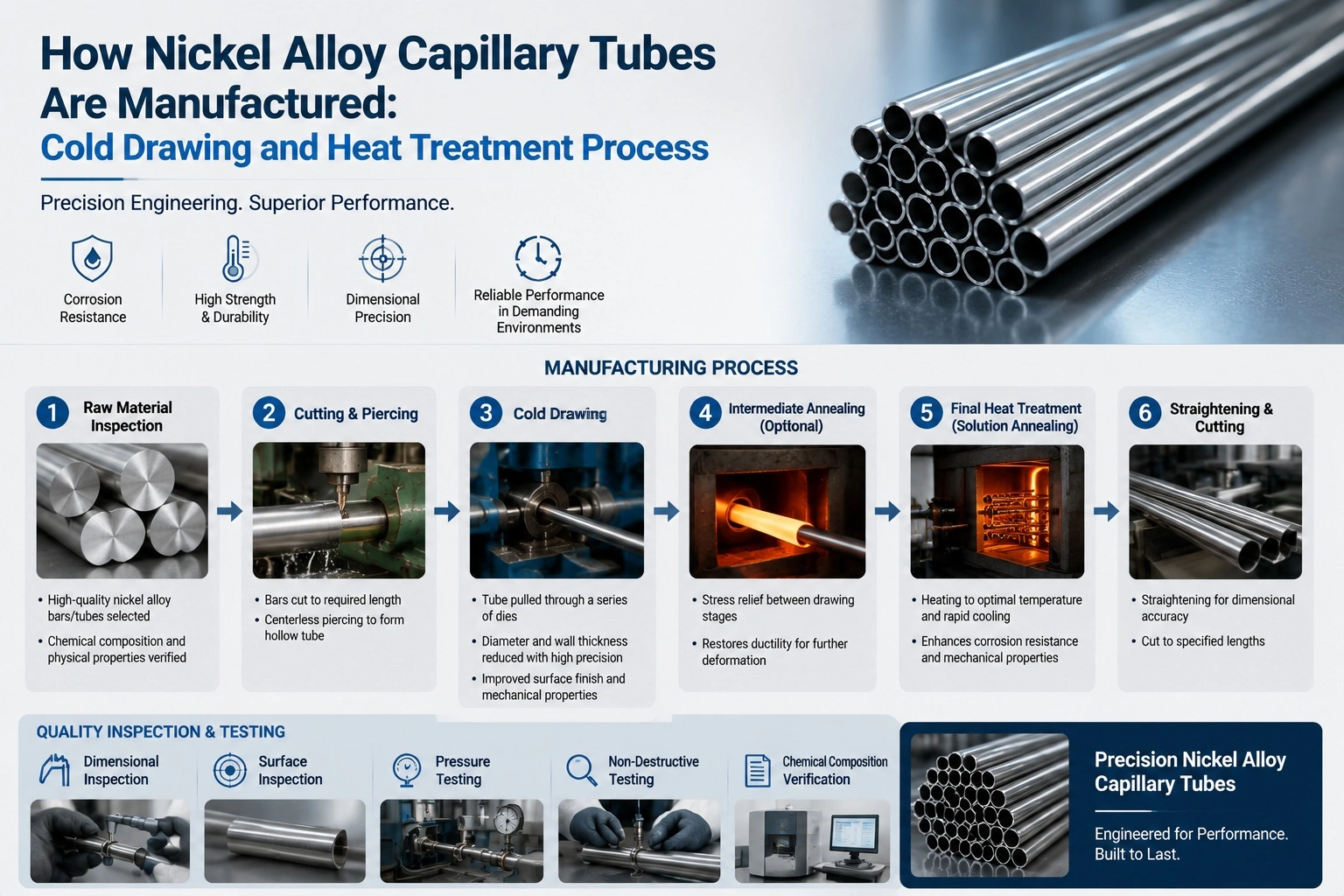
Manufacturing a Nickel Alloy Capillary Tube requires strict control over dimensions, material properties, and surface quality. Unlike standard industrial tubing, capillary tubes have very small diameters and thin walls. Even minor production variations can affect flow accuracy, pressure performance, and service life. The manufacturing process usually involves several precision steps, including raw material preparation, tube forming, cold drawing, heat treatment, surface finishing, and inspection. Among these processes, cold drawing and heat treatment play a key role in achieving the required mechanical properties and dimensional accuracy.
For industries such as chemical processing, aerospace, oil and gas, instrumentation, and power generation, reliable nickel alloy capillary tubing provides stable performance in high-temperature and corrosive environments. At TSM Technology, we manufacture nickel alloy tubes and precision tubing solutions for global industrial customers. Our production experience helps customers select suitable nickel alloys and tubing specifications for demanding applications.
What Makes Nickel Alloy Capillary Tube Different From Standard Tubing?
A nickel alloy capillary tube is a precision tube designed for applications that require precise fluid or gas control.
Compared with conventional tubing, capillary tubes typically require:
· Smaller outside diameters
· Tighter dimensional tolerances
· Controlled wall thickness
· Smooth internal surfaces
· High corrosion resistance
· Reliable mechanical strength
These requirements make the manufacturing process more demanding.
A small deviation in tube dimensions may influence:
· Flow rate accuracy
· Instrument response
· Pressure stability
· Connection performance
This is why manufacturers use advanced forming and inspection processes during production.
Raw Material Selection for Nickel Alloy Capillary Tubes
The manufacturing process starts with selecting the correct nickel alloy material.
Different applications require different alloy characteristics.
Common nickel alloys used for capillary tubes include:
|
Alloy |
Main Characteristics |
Typical Applications |
|
Inconel 600 |
Good oxidation and corrosion resistance |
Heat treatment equipment, chemical systems |
|
Inconel 625 |
High strength and excellent corrosion resistance |
Marine, aerospace, chemical processing |
|
Hastelloy C-276 |
Strong resistance to aggressive chemicals |
Chemical processing equipment |
|
Monel 400 |
Excellent seawater resistance |
Marine and offshore systems |
|
Incoloy 825 |
Good resistance to acids and chlorides |
Chemical and energy industries |
The selected alloy must match the operating environment, including:
· Temperature range
· Pressure conditions
· Chemical exposure
· Mechanical requirements
Proper material selection helps ensure long-term service performance.
Step-by-Step Manufacturing Process of Nickel Alloy Capillary Tubes
Producing precision nickel alloy tubing involves multiple controlled processes.
The main production stages include:
· Tube blank preparation
· Piercing or extrusion
· Cold drawing
· Intermediate heat treatment
· Straightening
· Surface treatment
· Final inspection
Each stage influences the final tube quality.
Tube Blank Preparation and Initial Forming
The manufacturing process begins with a nickel alloy billet or hollow tube blank.
The raw material must meet strict requirements for:
· Chemical composition
· Metallurgical structure
· Surface condition
Manufacturers often use processes such as extrusion or piercing to create the initial tube shape.
At this stage, the tube does not yet meet the final capillary tube dimensions.
The initial tube provides the foundation for later precision processing.
Cold Drawing Process for Nickel Alloy Capillary Tubes
Cold drawing is one of the most important steps in producing a Nickel Alloy Capillary Tube.
During cold drawing, the tube passes through a die that reduces:
· Outside diameter
· Wall thickness
· Cross-sectional area
The process improves dimensional accuracy and surface finish.
Benefits of Cold Drawing
Cold drawing provides several advantages:
Improved Dimensional Control
Capillary applications require precise measurements.
Cold drawing helps manufacturers achieve tighter tolerances.
Better Surface Finish
The process creates a smoother tube surface, which benefits:
· Fluid flow
· Cleaning processes
· Instrument connections
Increased Mechanical Strength
Cold deformation can improve tensile strength and hardness.
Consistent Tube Geometry
Repeated drawing passes help maintain stable dimensions throughout the tube length.
Why Multiple Cold Drawing Passes Are Required
Nickel alloys have high strength and excellent resistance to deformation.
Because of this, manufacturers usually cannot achieve final dimensions in a single drawing operation.
Multiple drawing steps may be required.
Between drawing operations, manufacturers often perform heat treatment to restore ductility.
This controlled process prevents:
· Cracking
· Excessive hardness
· Dimensional instability
The number of drawing passes depends on:
· Alloy grade
· Tube size
· Wall thickness
· Required properties
Heat Treatment Process After Cold Drawing
Heat treatment is another critical step in nickel alloy capillary tube manufacturing.
Cold drawing increases strength but also creates internal stress inside the material.
Heat treatment helps restore the material structure.
Common heat treatment purposes include:
· Stress relief
· Improved ductility
· Grain structure control
· Mechanical property adjustment
The exact temperature and holding time depend on the alloy specification.
Why Heat Treatment Matters
Proper heat treatment helps ensure:
· Stable mechanical properties
· Better forming performance
· Reduced internal stress
· Improved service reliability
Without suitable heat treatment, the tube may experience reduced performance during operation.
Surface Finishing and Cleaning Process
After cold drawing and heat treatment, manufacturers complete additional finishing processes.
Typical steps include:
· Straightening
· Cutting
· Pickling
· Cleaning
· Surface inspection
Surface quality is especially important for instrumentation and precision applications.
A clean internal surface helps reduce:
· Contamination risks
· Flow restrictions
· Installation problems
Quality Inspection of Nickel Alloy Capillary Tubes
Precision tubing requires strict quality control before delivery.
Common inspection methods include:
Chemical Composition Testing
This confirms the alloy meets required standards.
Testing verifies elements such as:
· Nickel
· Chromium
· Molybdenum
· Iron
· Other alloying elements
Dimensional Inspection
Manufacturers check:
· Outside diameter
· Wall thickness
· Length
· Straightness
Mechanical Testing
Testing may include:
· Tensile testing
· Hardness testing
· Elongation testing
Non-Destructive Testing
Common methods include:
· Eddy current testing
· Ultrasonic testing
· Hydrostatic testing
These inspections help identify possible defects without damaging the product.
Standards for Nickel Alloy Capillary Tube Production
Industrial nickel alloy tubing often follows international standards depending on the alloy and application.
Common specifications include:
· ASTM B163 for nickel alloy seamless tubes
· ASTM B444 for nickel-chromium-molybdenum alloy tubes
· ASTM B622 for seamless nickel alloy pipe and tube
· ASTM B626 for welded nickel alloy tubes
Standards define requirements for:
· Chemical composition
· Mechanical properties
· Manufacturing quality
· Testing procedures
Buyers should confirm the required standard before placing orders.
Applications That Require Precision Nickel Alloy Capillary Tubes
Because of their accuracy and corrosion resistance, nickel alloy capillary tubes are used in many industries.
Chemical Processing
Applications include:
· Sampling lines
· Analyzer systems
· Chemical injection systems
· Process instrumentation
Nickel alloys help maintain reliability in corrosive environments.
Oil and Gas
Capillary tubes are used in:
· Hydraulic control systems
· Downhole instrumentation
· Offshore monitoring equipment
Nickel alloys provide resistance against pressure, temperature, and corrosive fluids.
Aerospace
Aerospace systems require materials with stable performance.
Applications include:
· Sensor lines
· Hydraulic systems
· Fuel control systems
Power Generation
Nickel alloy tubing supports:
· Heat monitoring systems
· Instrumentation equipment
· High-temperature applications
How to Choose a Reliable Nickel Alloy Capillary Tube Supplier
Choosing the right supplier affects product quality and project reliability.
Important factors include:
Manufacturing Experience
Experienced manufacturers understand how cold drawing and heat treatment affect the performance of nickel alloys.
Production Capability
A capable supplier should have:
· Precision drawing equipment
· Heat treatment facilities
· Inspection systems
· Quality control procedures
Material Traceability
Industrial buyers often require:
· Material test certificates
· Production records
· Inspection reports
Customization Ability
Different projects may require customized:
· Alloy grades
· Dimensions
· Lengths
· Surface conditions
A flexible supplier can better support specialized requirements.
Why Manufacturing Process Matters for Nickel Alloy Capillary Tubes
The performance of a nickel alloy capillary tube depends heavily on manufacturing control.
Cold drawing provides:
· Accurate dimensions
· Better surface quality
· Improved strength
Heat treatment provides:
· Balanced mechanical properties
· Reduced internal stress
· Better long-term reliability
Together, these processes allow nickel alloy capillary tubes to perform in demanding industrial environments.
At TSM Technology Nickel Alloy Tube Products, we provide precision nickel alloy tubing solutions for customers requiring corrosion resistance, dimensional accuracy, and reliable performance.
For technical information, quotations, or customized nickel alloy capillary tube requirements, contact us at info@tsmnialloy.com.
Frequently Asked Questions
What is the main purpose of cold drawing in nickel alloy capillary tube production?
Cold drawing reduces tube dimensions while improving accuracy, surface finish, and mechanical strength.
Why is heat treatment needed after cold drawing?
Heat treatment removes internal stress caused by cold working and restores material ductility.
Are nickel alloy capillary tubes available in seamless designs?
Yes. Seamless nickel alloy capillary tubes are widely used for applications requiring high reliability and pressure resistance.
Which nickel alloy is suitable for chemical processing?
The suitable alloy depends on the chemical environment. Hastelloy and Inconel grades are commonly selected for demanding corrosion conditions.
Can nickel alloy capillary tubes be customized?
Yes. Manufacturers can customize alloy grade, diameter, wall thickness, length, and surface requirements based on project needs.
References
1. ASTM International. ASTM B163 Standard Specification for Seamless Nickel and Nickel Alloy Condenser and Heat-Exchanger Tubes.
2. ASTM International. ASTM B622 Standard Specification for Seamless Nickel and Nickel-Cobalt Alloy Pipe and Tube.
3. ASM International. Properties and Selection: Nonferrous Alloys and Special-Purpose Materials.
4. Davis, Joseph R. Nickel, Cobalt, and Their Alloys. ASM International.
5. Special Metals Corporation. High-Performance Nickel Alloys Technical Information.
6. Donachie, Matthew J. Superalloys: A Technical Guide. ASM International.
Learn about our latest products and discounts through SMS or email