- English
- French
- German
- Portuguese
- Spanish
- Russian
- Japanese
- Korean
- Arabic
- Greek
- German
- Turkish
- Italian
- Danish
- Romanian
- Indonesian
- Czech
- Afrikaans
- Swedish
- Polish
- Basque
- Catalan
- Esperanto
- Hindi
- Lao
- Albanian
- Amharic
- Armenian
- Azerbaijani
- Belarusian
- Bengali
- Bosnian
- Bulgarian
- Cebuano
- Chichewa
- Corsican
- Croatian
- Dutch
- Estonian
- Filipino
- Finnish
- Frisian
- Galician
- Georgian
- Gujarati
- Haitian
- Hausa
- Hawaiian
- Hebrew
- Hmong
- Hungarian
- Icelandic
- Igbo
- Javanese
- Kannada
- Kazakh
- Khmer
- Kurdish
- Kyrgyz
- Latin
- Latvian
- Lithuanian
- Luxembou..
- Macedonian
- Malagasy
- Malay
- Malayalam
- Maltese
- Maori
- Marathi
- Mongolian
- Burmese
- Nepali
- Norwegian
- Pashto
- Persian
- Punjabi
- Serbian
- Sesotho
- Sinhala
- Slovak
- Slovenian
- Somali
- Samoan
- Scots Gaelic
- Shona
- Sindhi
- Sundanese
- Swahili
- Tajik
- Tamil
- Telugu
- Thai
- Ukrainian
- Urdu
- Uzbek
- Vietnamese
- Welsh
- Xhosa
- Yiddish
- Yoruba
- Zulu
What Is Nickel Alloy Capillary Tube? A Complete Guide for Industrial Applications
What Is Nickel Alloy Capillary Tube?
A Nickel Alloy Capillary Tube is a precision tube with a very small outside diameter and a thin wall. It is designed for applications that require accurate fluid or gas transfer, excellent corrosion resistance, and reliable performance under high pressure or extreme temperatures. Because nickel alloys maintain their mechanical properties in harsh environments, capillary tubes made from these materials are widely used in chemical processing, oil and gas, instrumentation, medical equipment, aerospace, and power generation. Unlike standard industrial tubing, capillary tubing focuses on dimensional accuracy, surface quality, and pressure integrity. These features allow engineers to control fluid flow with high precision while reducing the risk of leakage or corrosion.
At TSM Technology, we manufacture high-quality nickel alloy capillary tubes for customers worldwide. Our products are available in multiple nickel alloy grades and can be customized to meet demanding industrial requirements.
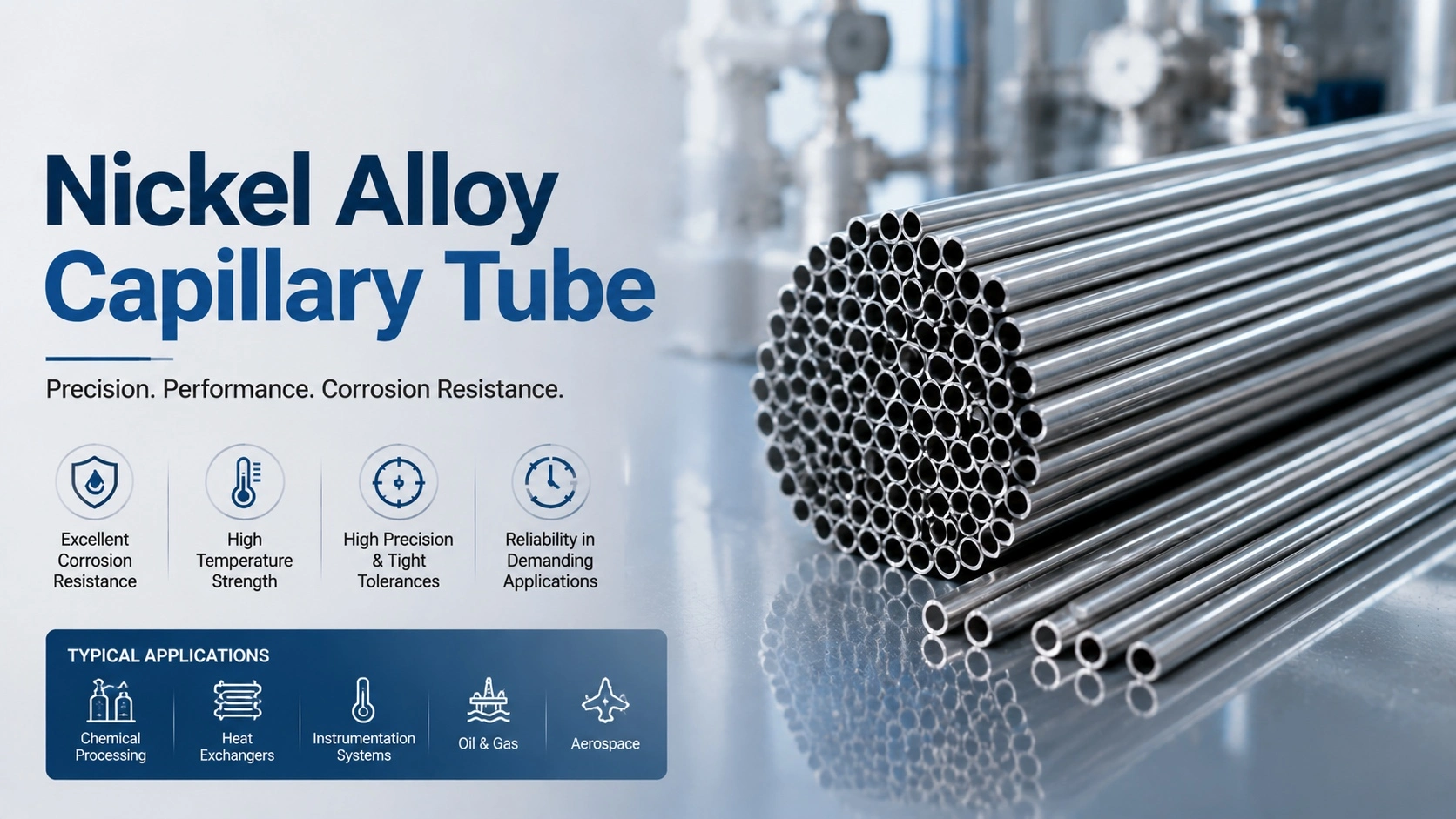
What Is a Nickel Alloy Capillary Tube?
A nickel alloy capillary tube is a seamless or welded precision tube with a small outside diameter, tight dimensional tolerances, and excellent mechanical properties.
Compared with conventional tubes, capillary tubes feature:
· Small outside diameters
· Thin wall thicknesses
· High dimensional accuracy
· Smooth internal surfaces
· Excellent corrosion resistance
· High pressure capability
Their compact size allows them to transport liquids and gases accurately in systems where space is limited.
Many industries depend on capillary tubing to maintain stable system performance and measurement accuracy.
What Materials Are Used for Nickel Alloy Capillary Tubes?
Several nickel-based alloys are commonly used depending on the operating environment.
Popular materials include:
· Inconel 600
· Inconel 625
· Inconel 718
· Incoloy 800
· Incoloy 825
· Monel 400
· Monel K500
· Hastelloy C-276
· Hastelloy C-22
· Nickel 200
· Nickel 201
Each alloy offers different advantages in corrosion resistance, temperature capability, and mechanical strength.
Material selection depends on the media, pressure, temperature, and service environment.
Why Are Nickel Alloys Used for Capillary Tubes?
Nickel alloys perform well where stainless steel may no longer provide sufficient corrosion resistance.
Their advantages include:
Excellent Corrosion Resistance
Nickel alloys resist many aggressive environments, including:
· Chloride solutions
· Acids
· Alkalis
· Seawater
· Oxidizing chemicals
This helps extend equipment service life.
High Temperature Performance
Many nickel alloys retain strength at elevated temperatures.
This makes them suitable for furnaces, heat exchangers, and aerospace systems.
Good Pressure Resistance
Capillary tubing often operates in high-pressure instrumentation systems.
Nickel alloys provide excellent strength while maintaining dimensional stability.
Excellent Oxidation Resistance
Many nickel alloys form stable protective oxide layers that reduce surface degradation during long-term service.
Long Service Life
Superior corrosion resistance reduces maintenance costs and equipment replacement frequency.
How Are Nickel Alloy Capillary Tubes Manufactured?
Precision manufacturing is essential because dimensional accuracy directly affects product performance.
Typical production processes include:
· Raw material preparation
· Tube extrusion or piercing
· Cold drawing
· Intermediate annealing
· Straightening
· Precision cutting
· Surface finishing
· Non-destructive testing
· Final inspection
Each production stage helps achieve:
· Tight dimensional tolerances
· Smooth internal surfaces
· Stable mechanical properties
Reliable manufacturers also perform comprehensive quality inspections before shipment.
Seamless vs. Welded Nickel Alloy Capillary Tubes
Both seamless and welded tubes are available for different applications.
|
Feature |
Seamless Capillary Tube |
Welded Capillary Tube |
|
Pressure Resistance |
Excellent |
Good |
|
Corrosion Resistance |
Excellent |
Excellent |
|
Mechanical Strength |
Higher |
Good |
|
Dimensional Accuracy |
Excellent |
Excellent |
|
Critical Applications |
Preferred |
Suitable for many industrial uses |
Many instrumentation and aerospace applications prefer seamless tubing because it eliminates the weld seam.
Common Applications of Nickel Alloy Capillary Tubes
Nickel alloy capillary tubing supports many industries where precision and corrosion resistance are critical.
Instrumentation Systems
Instrumentation tubing transports process fluids to measuring devices.
Typical applications include:
· Pressure transmitters
· Flow meters
· Temperature sensors
· Analytical instruments
High dimensional accuracy helps improve measurement reliability.
Chemical Processing
Chemical plants handle aggressive chemicals every day.
Nickel alloy capillary tubes are used in:
· Sampling systems
· Chemical injection lines
· Heat exchangers
· Process analyzers
Their corrosion resistance helps reduce maintenance.
Oil and Gas Industry
Oil and gas equipment often operates under:
· High pressure
· High temperature
· Corrosive production fluids
Capillary tubing supports:
· Downhole control lines
· Hydraulic systems
· Chemical injection systems
· Offshore instrumentation
Medical Equipment
Medical devices require precision tubing with excellent cleanliness.
Applications include:
· Laboratory instruments
· Medical analyzers
· Diagnostic equipment
Aerospace Industry
Aircraft and aerospace systems require lightweight materials with outstanding reliability.
Nickel alloy capillary tubing appears in:
· Hydraulic systems
· Fuel control systems
· Sensor assemblies
· High-temperature engine components
Power Generation
Power plants use nickel alloy tubing in:
· Steam systems
· Heat exchangers
· Instrumentation
· Boiler monitoring equipment
How to Choose the Right Nickel Alloy Capillary Tube
Selecting the correct material depends on several operating conditions.
Consider the following factors:
Corrosion Environment
Identify whether the system contains:
· Acids
· Chlorides
· Seawater
· High-purity chemicals
Different alloys provide different corrosion resistance.
Operating Temperature
High-temperature systems often require Inconel or Incoloy grades.
Operating Pressure
Higher pressures generally require seamless tubing with appropriate wall thickness.
Dimensional Requirements
Confirm:
· Outside diameter
· Inside diameter
· Wall thickness
· Length tolerance
Industry Standards
Many projects specify ASTM or ASME material standards.
Always verify the required specifications before purchasing.
Quality Control for Nickel Alloy Capillary Tubes
Reliable manufacturers apply strict inspection procedures throughout production.
Common quality inspections include:
· Chemical composition analysis
· Mechanical property testing
· Dimensional inspection
· Eddy current testing
· Ultrasonic testing
· Hydrostatic testing
· Surface inspection
These tests help ensure consistent product quality and traceability.
Why Choose an Experienced Nickel Alloy Tube Supplier?
Nickel alloy capillary tubing requires advanced manufacturing equipment and strict process control.
Before selecting a supplier, buyers should evaluate:
Manufacturing Capability
Look for suppliers with:
· Precision cold drawing equipment
· Heat treatment facilities
· Modern inspection systems
Product Range
A supplier offering multiple nickel alloy grades can better support different applications.
Quality Management
Choose manufacturers that provide:
· Material Test Certificates (MTC)
· Full traceability
· Non-destructive testing
· Dimensional inspection reports
Export Experience
International projects require secure packaging, reliable logistics, and responsive technical support.
Why Choose TSM Nialloy?
At TSM Technology, we specialize in manufacturing high-performance nickel alloy tubes for demanding industrial applications.
Our product range includes:
· Nickel Alloy Capillary Tubes
· Seamless Nickel Alloy Tubes
· Welded Nickel Alloy Tubes
· Heat Exchanger Tubes
· U Tubes
· Coiled Tubes
· Custom Nickel Alloy Tubing
We supply products manufactured to international standards while providing strict quality control and global delivery support. Whether your project involves instrumentation, chemical processing, aerospace, or offshore engineering, our engineering team can help you select the right material for your application. For technical assistance, pricing, or custom manufacturing solutions, please contact us at info@tsmnialloy.com.
Frequently Asked Questions
What is a nickel alloy capillary tube used for?
It is used for precise fluid or gas transfer in instrumentation, chemical processing, medical devices, aerospace, oil and gas, and power generation.
Are nickel alloy capillary tubes seamless?
They are available in both seamless and welded forms. Seamless tubes are often selected for high-pressure and critical applications.
Which nickel alloy is best for corrosive environments?
The best alloy depends on the operating conditions. Hastelloy grades are widely used for highly corrosive chemical media, while Inconel and Monel alloys perform well in high-temperature and marine environments.
Can nickel alloy capillary tubes be customized?
Yes. Manufacturers can produce customized outside diameters, wall thicknesses, lengths, and alloy grades to meet specific project requirements.
How do I choose the right capillary tube?
Consider the operating temperature, pressure, corrosion environment, dimensional requirements, and applicable material standards before selecting the alloy.
References
1. ASTM International. ASTM B622 Standard Specification for Seamless Nickel and Nickel-Cobalt Alloy Pipe and Tube.
2. ASTM International. ASTM B619 Standard Specification for Welded Nickel and Nickel-Cobalt Alloy Pipe.
3. ASTM International. ASTM B626 Standard Specification for Welded Nickel and Nickel-Cobalt Alloy Tube.
4. ASM International. Properties and Selection: Irons, Steels, and High-Performance Alloys.
5. Davis, Joseph R. Nickel, Cobalt, and Their Alloys. ASM International.
6. Special Metals Corporation. High-Performance Nickel Alloys for Corrosion and Heat Resistant Applications.
Learn about our latest products and discounts through SMS or email