- English
- French
- German
- Portuguese
- Spanish
- Russian
- Japanese
- Korean
- Arabic
- Greek
- German
- Turkish
- Italian
- Danish
- Romanian
- Indonesian
- Czech
- Afrikaans
- Swedish
- Polish
- Basque
- Catalan
- Esperanto
- Hindi
- Lao
- Albanian
- Amharic
- Armenian
- Azerbaijani
- Belarusian
- Bengali
- Bosnian
- Bulgarian
- Cebuano
- Chichewa
- Corsican
- Croatian
- Dutch
- Estonian
- Filipino
- Finnish
- Frisian
- Galician
- Georgian
- Gujarati
- Haitian
- Hausa
- Hawaiian
- Hebrew
- Hmong
- Hungarian
- Icelandic
- Igbo
- Javanese
- Kannada
- Kazakh
- Khmer
- Kurdish
- Kyrgyz
- Latin
- Latvian
- Lithuanian
- Luxembou..
- Macedonian
- Malagasy
- Malay
- Malayalam
- Maltese
- Maori
- Marathi
- Mongolian
- Burmese
- Nepali
- Norwegian
- Pashto
- Persian
- Punjabi
- Serbian
- Sesotho
- Sinhala
- Slovak
- Slovenian
- Somali
- Samoan
- Scots Gaelic
- Shona
- Sindhi
- Sundanese
- Swahili
- Tajik
- Tamil
- Telugu
- Thai
- Ukrainian
- Urdu
- Uzbek
- Vietnamese
- Welsh
- Xhosa
- Yiddish
- Yoruba
- Zulu
Why Nickel Alloys Are Essential for Modern Water Treatment and Desalination Systems
Access to clean and reliable water is becoming one of the world's greatest engineering challenges. Rapid population growth, industrial expansion, urbanization, and climate change are placing unprecedented pressure on freshwater resources. According to international reports from the World Bank, WHO, and UNICEF, billions of people are expected to experience water stress over the coming decades, making investment in resilient water infrastructure more important than ever.
While pumps, membranes, filtration technologies, and automation often receive the most attention, the materials used to build water treatment systems are equally critical. Every pipeline, heat exchanger, storage tank, valve, pump casing, and pressure vessel must operate continuously in environments containing chlorides, dissolved oxygen, treatment chemicals, acidic or alkaline media, and microbiological contaminants. Material failure can lead to leaks, contamination, costly downtime, and shortened equipment life. For this reason, engineers increasingly select corrosion-resistant nickel alloys and high-performance stainless steels to improve system reliability and reduce life-cycle costs.
At TSM Technology, we manufacture nickel alloy pipes, tubes, fittings, flanges, forgings, and custom-machined components for demanding industries including water treatment, desalination, chemical processing, marine engineering, and energy. This article explains why nickel-containing materials have become indispensable throughout the modern water cycle.
Global Water Challenges Demand Better Materials
The demand for clean water continues to rise worldwide. Energy production, industrial manufacturing, agriculture, and growing cities all require significant volumes of treated water. At the same time, aging infrastructure causes substantial water losses through corrosion and pipeline leakage.
Many conventional water systems were originally constructed using carbon steel, galvanized steel, cast iron, or concrete-lined pipes. Although these materials offered acceptable performance decades ago, they often require frequent maintenance, protective coatings, and eventual replacement when exposed to corrosive environments.
Modern water infrastructure is expected to operate for decades with minimal maintenance. This expectation has accelerated the adoption of nickel-containing alloys that combine excellent corrosion resistance with high mechanical strength and outstanding durability.
Why Nickel Alloys Perform Better in Water Systems
Superior Corrosion Resistance
Corrosion is the primary cause of failure in water treatment equipment.
Water may contain chlorides, sulfates, dissolved oxygen, carbon dioxide, microorganisms, and treatment chemicals such as chlorine or ozone. These substances continuously attack metallic components.
Nickel improves the stability of protective passive films, allowing stainless steels and nickel alloys to resist:
- General corrosion
- Pitting corrosion
- Crevice corrosion
- Stress corrosion cracking
- Chemical attack
Microbiologically influenced corrosion (MIC)
This protection significantly extends equipment life compared with conventional materials.
Long Service Life
Many nickel-containing materials remain in service for over 50 years, and properly designed systems can exceed 100 years with minimal degradation.
A longer service life means:
Lower replacement costs
Reduced maintenance
Fewer production shutdowns
Improved operational safety
Better return on investment
Although the initial material cost may be higher, the total life-cycle cost is often considerably lower.
High Mechanical Strength
Modern water systems frequently operate under high pressures and high flow velocities.
Duplex stainless steels and several nickel alloys provide significantly higher strength than conventional stainless steels, allowing engineers to reduce wall thickness while maintaining structural integrity.
Advantages include:
Lower weight
Easier transportation
Reduced installation costs
Improved pressure resistance
Excellent Fabrication Performance
Nickel alloys can be fabricated into pipes, tubes, fittings, flanges, forgings, pressure vessels, and custom-machined components.
They are compatible with modern welding and machining processes and can be manufactured according to ASTM, ASME, and international industrial standards.
Applications Throughout the Water Cycle
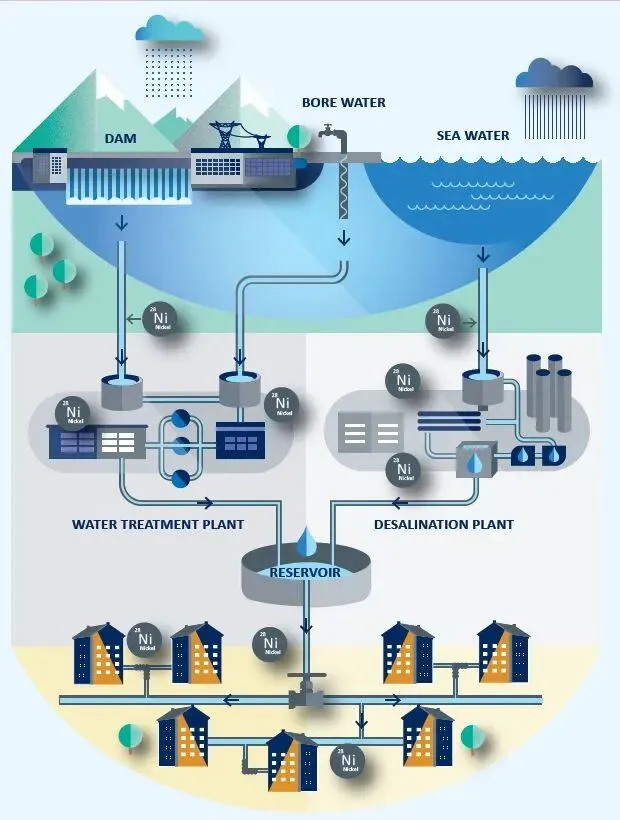
Nickel-containing materials support every stage of water production, transportation, treatment, reuse, and desalination.
1. Drinking Water Treatment
Raw water from rivers, lakes, or groundwater sources requires multiple treatment stages before becoming safe drinking water.
Typical equipment includes:
Clarifiers
Filters
Storage tanks
Chemical dosing systems
Pump stations
Distribution pipelines
Austenitic stainless steels such as 304 and 316 are commonly used for general service because they provide clean surfaces, excellent corrosion resistance, and low maintenance requirements.
Where chloride concentrations increase or aggressive chemicals are introduced, higher-alloy materials become more suitable.
2.Water Distribution Networks
Pipeline leakage remains a major challenge in municipal water systems.
Corrosion gradually weakens carbon steel and cast iron pipelines, resulting in water losses and expensive repairs.
Nickel-containing stainless steels offer several advantages:
Smooth internal surfaces
Excellent corrosion resistance
High flow capacity
Long operating life
Low maintenance
Flexible stainless steel piping systems have also simplified installation in complex urban environments.
Many cities have successfully upgraded aging infrastructure using stainless steel service lines to reduce leakage and improve long-term reliability.
3. Building Water Supply Systems
Hospitals, commercial buildings, hotels, airports, and residential developments increasingly specify stainless steel piping systems.
Compared with plastic or galvanized pipes, stainless steel offers:
Hygienic surfaces
Excellent durability
High pressure capability
No internal coatings
Minimal maintenance
Modern press-fit connection systems further reduce installation time while maintaining reliable leak-free performance.
4. Wastewater Treatment
Wastewater environments are significantly more aggressive than drinking water systems.
Typical corrosion sources include:
Hydrogen sulfide (H₂S)
Sulfuric acid
Chlorides
Organic acids
Industrial chemicals
These environments can rapidly destroy conventional materials.
Nickel-containing stainless steels and nickel alloys are widely used for:
Sludge treatment
Aeration systems
Pumps
Screens
Valves
Pipework
Digestion equipment
Proper fabrication, pickling, passivation, and clean hydrostatic testing are essential to maximize corrosion resistance.
5. Seawater Desalination
Desalination has become one of the fastest-growing sectors of global water infrastructure.
Reverse osmosis (RO) plants operate under extremely demanding conditions.
High-pressure seawater contains:
High chloride concentrations
Dissolved oxygen
Marine microorganisms
Sand particles
Elevated pressures
These conditions rapidly damage ordinary steels.
Engineers therefore select advanced corrosion-resistant materials for:
High-pressure pumps
Pressure vessels
Intake systems
Heat exchangers
Valves
Piping systems
Super duplex stainless steels and high-performance nickel alloys are widely recognized as the preferred solutions for long-term reliability in seawater service.
Choosing the Right Nickel Alloy
Selecting the appropriate alloy depends on water chemistry, chloride concentration, operating temperature, pressure, and maintenance expectations.
Hastelloy C-276
Hastelloy C-276 is one of the industry's most versatile corrosion-resistant alloys.
Typical applications include:
Chemical dosing systems
Wastewater treatment
Acid handling
Chlorinated process streams
Scrubber systems
Its outstanding resistance to oxidizing and reducing chemicals makes it an excellent choice for highly aggressive environments.
Hastelloy C-22
Hastelloy C-22 provides exceptional resistance against localized corrosion.
It performs particularly well where oxidizing chemicals and chlorides coexist.
Common applications include:
Water treatment chemical systems
Process piping
Storage vessels
Industrial wastewater facilities
Inconel 625
Inconel 625 combines high strength with excellent seawater corrosion resistance.
Typical applications include:
Offshore desalination
Marine pumps
Heat exchangers
Pressure piping
High-pressure systems
Alloy 825
Alloy 825 performs well in acidic process environments.
It is frequently selected for:
Sulfuric acid systems
Phosphoric acid processing
Industrial wastewater
Chemical transfer lines
Super Duplex Stainless Steel
Super Duplex grades are often selected where excellent chloride resistance and high mechanical strength are required.
Applications include:
Seawater piping
Reverse osmosis plants
Offshore platforms
Firewater systems
They provide an excellent balance between corrosion resistance and cost for many seawater applications.
Nickel Alloys vs Conventional Materials
| Material | Corrosion Resistance | Strength | Maintenance | Typical Applications |
|---|---|---|---|---|
| Carbon Steel | Poor | High | High | Temporary or protected systems |
| 304 Stainless Steel | Good | Moderate | Low | Drinking water |
| 316 Stainless Steel | Better | Moderate | Low | Chloride-containing water |
| Duplex Stainless Steel | Excellent | Very High | Very Low | Municipal water, seawater |
| Nickel Alloys | Outstanding | High | Very Low | Chemical processing, wastewater, desalination |
Although nickel alloys generally have higher initial costs, they often provide the lowest total ownership cost over decades of operation.
Lower Life-Cycle Costs
Material selection should never be based solely on purchase price.
The true cost of ownership includes:
Installation
Maintenance
Shutdowns
Repairs
Replacement
Production losses
Safety risks
A pipe that lasts 50 to 100 years with minimal maintenance often proves more economical than a lower-cost alternative requiring repeated repairs.
For this reason, engineers increasingly evaluate projects based on life-cycle cost rather than initial investment.
Why Material Selection Matters in Desalination Projects
Desalination plants represent one of the most demanding corrosion environments in modern industry.
Failure of a single high-pressure component can interrupt production and generate substantial maintenance costs.
Selecting appropriate materials helps operators achieve:
Higher plant availability
Lower maintenance expenses
Longer equipment life
Greater operational safety
Improved energy efficiency
As desalination capacity continues to expand worldwide, demand for corrosion-resistant nickel alloys is expected to grow steadily.
Why Choose TSM Technology
TSM Technology is a trusted manufacturer of high-performance titanium and nickel alloy products for critical industrial applications.
Our capabilities include:
- Nickel alloy pipes and tubes
- Nickel alloy fittings and flanges
- Forgings
- Bars and plates
- Custom-machined components
We manufacture products according to international standards and maintain strict quality control throughout production.
Our advantages include:
- More than 14 years of manufacturing experience
- 60,000 m² production facility
- Integrated production from raw materials to finished products
- Advanced melting, forging, machining, and inspection equipment
- Non-destructive testing and full material traceability
- Global supply for chemical, marine, energy, desalination, and water treatment industries
Whether your project requires standard products or custom-engineered solutions, our technical team can help you select the most suitable material for long-term performance.
Frequently Asked Questions
What are nickel alloys used for in water treatment?
Nickel alloys are used in pumps, pipelines, valves, heat exchangers, pressure vessels, chemical dosing equipment, and wastewater treatment systems where superior corrosion resistance is required.
Which material is best for seawater piping?
Super duplex stainless steels and high-performance nickel alloys are generally preferred because they resist chloride-induced corrosion far better than conventional materials.
Why are nickel alloys used in desalination plants?
Desalination systems operate under high pressure and high chloride concentrations. Nickel alloys provide the corrosion resistance and durability needed for long-term operation.
Are nickel alloys better than stainless steel?
Not always. Standard stainless steels are sufficient for many drinking water applications, while nickel alloys become the preferred choice in highly corrosive chemical or seawater environments.
How long can nickel alloy piping last?
With proper design, fabrication, and maintenance, nickel alloy piping systems can provide reliable service for several decades, and in many cases more than 100 years.
Conclusion
As global demand for clean water continues to grow, durable and corrosion-resistant materials will play an increasingly important role in ensuring reliable water infrastructure.
From municipal drinking water networks and wastewater treatment facilities to large-scale seawater desalination plants, nickel-containing materials have become the benchmark for long-term performance. Their exceptional corrosion resistance, mechanical strength, low maintenance requirements, and extended service life help reduce operational costs while improving system reliability.
For engineers, EPC contractors, and equipment manufacturers, selecting the right nickel alloy is not simply a material choice—it is a long-term investment in safety, efficiency, and sustainability.
If you are sourcing high-quality nickel alloy pipes, tubes, fittings, flanges, or custom components for water treatment or desalination projects, TSM Technology is ready to support your next project with reliable manufacturing, strict quality control, and global supply capabilities.
Contact us
If you are looking for high-quality nickel alloy tubes, nickel alloy bars, or custom forged nickel alloy products, our experienced manufacturing team can provide reliable material solutions for demanding industrial applications.
Email: info@tsmnialloy.com
Learn about our latest products and discounts through SMS or email