- English
- French
- German
- Portuguese
- Spanish
- Russian
- Japanese
- Korean
- Arabic
- Greek
- German
- Turkish
- Italian
- Danish
- Romanian
- Indonesian
- Czech
- Afrikaans
- Swedish
- Polish
- Basque
- Catalan
- Esperanto
- Hindi
- Lao
- Albanian
- Amharic
- Armenian
- Azerbaijani
- Belarusian
- Bengali
- Bosnian
- Bulgarian
- Cebuano
- Chichewa
- Corsican
- Croatian
- Dutch
- Estonian
- Filipino
- Finnish
- Frisian
- Galician
- Georgian
- Gujarati
- Haitian
- Hausa
- Hawaiian
- Hebrew
- Hmong
- Hungarian
- Icelandic
- Igbo
- Javanese
- Kannada
- Kazakh
- Khmer
- Kurdish
- Kyrgyz
- Latin
- Latvian
- Lithuanian
- Luxembou..
- Macedonian
- Malagasy
- Malay
- Malayalam
- Maltese
- Maori
- Marathi
- Mongolian
- Burmese
- Nepali
- Norwegian
- Pashto
- Persian
- Punjabi
- Serbian
- Sesotho
- Sinhala
- Slovak
- Slovenian
- Somali
- Samoan
- Scots Gaelic
- Shona
- Sindhi
- Sundanese
- Swahili
- Tajik
- Tamil
- Telugu
- Thai
- Ukrainian
- Urdu
- Uzbek
- Vietnamese
- Welsh
- Xhosa
- Yiddish
- Yoruba
- Zulu
Monel vs Nickel Alloy Tubes: Best Choice for Seawater and Marine Applications
Marine environments are among the most challenging conditions for metal materials. Continuous seawater exposure, chloride ions, pressure changes, and temperature variations can accelerate corrosion and reduce equipment life. Selecting the right tubing material is essential for reliable marine operations.
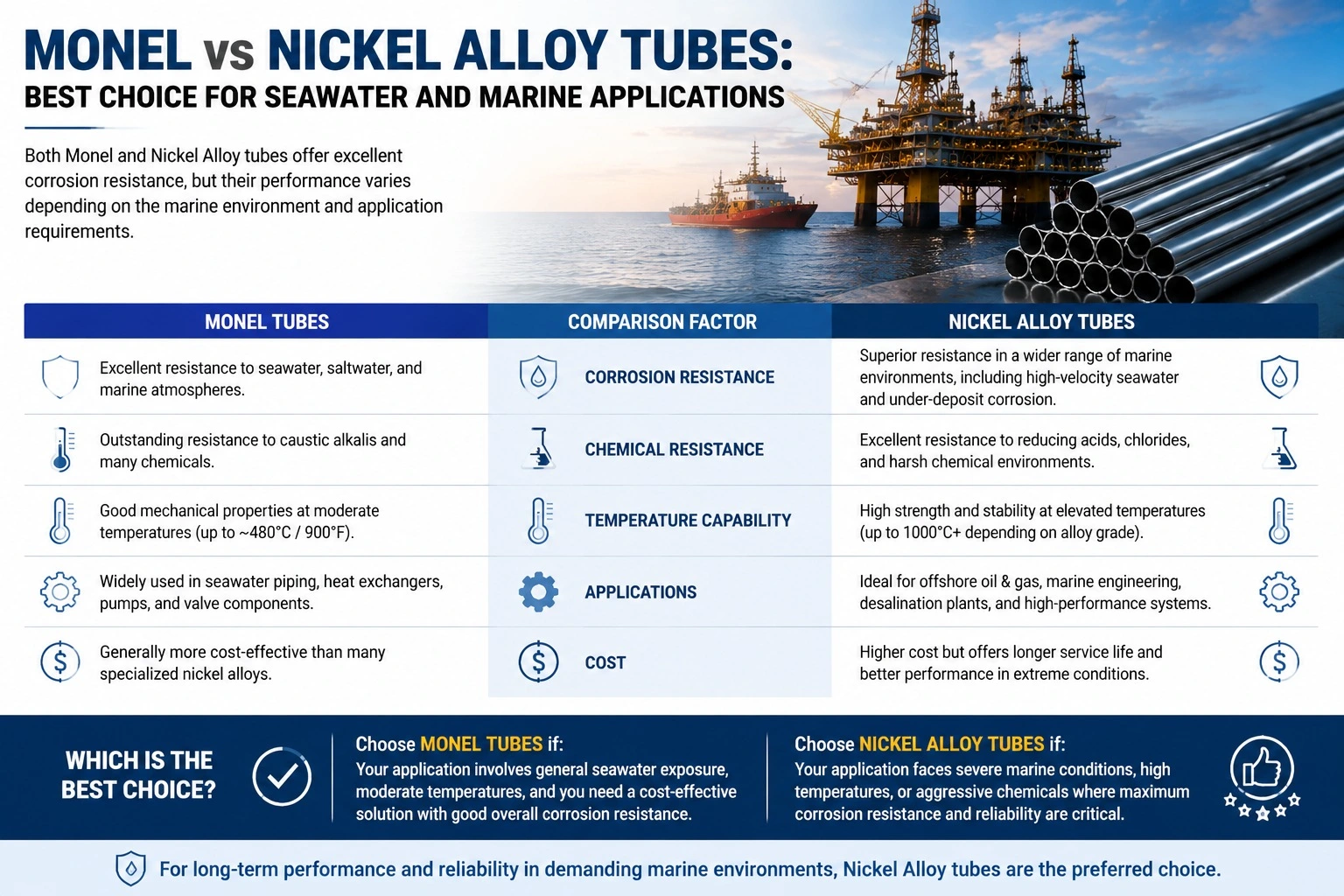
A Nickel Alloy Capillary Tube is widely used in marine and offshore systems because of its corrosion resistance, mechanical strength, and precision performance. Monel alloys are also popular choices for seawater applications due to their excellent resistance to saltwater corrosion.
When engineers compare Monel tubes and nickel alloy tubes, the best choice depends on the specific operating environment, temperature, chemical exposure, and mechanical requirements.
At TSM Technology, we provide nickel alloy tubing solutions for demanding industries, including marine, offshore oil and gas, chemical processing, and energy applications. Our products focus on reliable material performance, accurate dimensions, and consistent quality.
Why Material Selection Is Important in Marine Applications
Marine equipment operates in environments where corrosion protection is critical.
Seawater contains:
· Chlorides
· Dissolved oxygen
· Salts
· Marine microorganisms
These factors can cause:
· Pitting corrosion
· Crevice corrosion
· Stress corrosion cracking
· Surface degradation
Tubing used in marine systems must maintain performance over long periods because repairs are often difficult and expensive.
Common marine applications include:
· Heat exchangers
· Seawater cooling systems
· Hydraulic control systems
· Offshore equipment
· Desalination systems
· Ship instrumentation
The right alloy selection can improve reliability and reduce maintenance costs.
What Is a Nickel Alloy Capillary Tube?
A Nickel Alloy Capillary Tube is a precision tube manufactured from nickel-based alloys.
It features:
· Small diameter design
· Controlled wall thickness
· Accurate dimensions
· High corrosion resistance
· Reliable mechanical performance
Capillary tubes are commonly used where precise fluid or gas control is required.
Marine applications often require tubing that can handle:
· Seawater exposure
· Hydraulic pressure
· Chemical injection fluids
· Long-term operation
Nickel alloy capillary tubes provide a combination of precision and durability.
What Is Monel and Why Is It Used in Marine Applications?
Monel is a nickel-copper alloy family known for excellent seawater corrosion resistance.
The most common grade is Monel 400.
Monel provides:
· Excellent resistance to seawater
· Good resistance to salt solutions
· Good mechanical properties
· Stable performance in marine environments
Because of these characteristics, Monel has been used in marine engineering for many years.
Typical applications include:
· Marine piping systems
· Pump components
· Valve parts
· Heat exchangers
· Offshore equipment
Monel vs Nickel Alloy Tubes: Main Differences
Monel and other nickel alloys both provide corrosion resistance, but their compositions and strengths differ.
|
Feature |
Monel Tubes |
Nickel Alloy Tubes |
|
Main Elements |
Nickel-Copper |
Nickel-Chromium / Nickel-Molybdenum Systems |
|
Seawater Resistance |
Excellent |
Excellent |
|
Acid Resistance |
Moderate |
Excellent depending on alloy |
|
High Temperature Performance |
Good |
Excellent depending on grade |
|
Chemical Processing Use |
Limited |
Widely Used |
|
Marine Applications |
Excellent |
Excellent |
The better option depends on the service environment.
Corrosion Resistance in Seawater: Monel vs Nickel Alloys
Monel Performance in Seawater
Monel has excellent resistance to seawater corrosion.
It performs well in:
· Marine atmosphere
· Saltwater systems
· Flowing seawater
· Marine equipment
Its nickel-copper structure provides strong protection against many seawater-related corrosion problems.
However, Monel may not be the best choice for every chemical environment.
Nickel Alloy Performance in Seawater
Nickel alloys such as Inconel and Hastelloy provide different corrosion advantages.
They can offer stronger resistance against:
· Acidic solutions
· Chloride-containing chemicals
· High-temperature corrosion
Some nickel alloys are selected for offshore systems where seawater exposure combines with aggressive process fluids.
Which Material Performs Better in Offshore Marine Systems?
Offshore equipment faces more than seawater exposure.
Systems may encounter:
· High pressure
· Hydrogen sulfide
· Carbon dioxide
· Chemical injection fluids
· Elevated temperatures
For basic seawater service, Monel can be an excellent option.
For more complex offshore environments, advanced nickel alloys may provide additional advantages.
Applications include:
Subsea Control Systems
Require tubing with:
· High corrosion resistance
· Pressure capability
· Long service life
Chemical Injection Lines
Require resistance against injected chemicals and seawater exposure.
Offshore Instrumentation
Require precise dimensions and stable performance.
Marine Applications of Nickel Alloy Capillary Tubes
A Nickel Alloy Capillary Tube supports many marine and offshore systems.
Seawater Heat Exchangers
Heat exchangers use seawater for cooling in ships and offshore platforms.
Tubing materials must resist:
· Chloride corrosion
· Temperature cycling
· Long-term seawater contact
01
Hydraulic Control Systems
Hydraulic systems operate marine equipment such as:
· Subsea valves
· Offshore control systems
· Marine machinery
Precision tubing helps maintain reliable fluid control.
02
Desalination Equipment
Desalination plants process large amounts of seawater.
Tubing must resist:
· Salt concentration
· Corrosion
· Continuous operation
Nickel alloys are often considered for these demanding systems.
03
Marine Instrumentation
Monitoring systems require accurate fluid transmission.
Capillary tubes support:
· Pressure sensors
· Measurement devices
· Control equipment
04
High Temperature Performance Comparison
Temperature requirements can influence material selection.
Monel Temperature Performance
Monel performs well in many marine applications but has more limited high-temperature capability compared with some nickel-chromium alloys.
Nickel Alloy Temperature Performance
Many nickel alloys maintain strength at elevated temperatures.
This makes them suitable for:
· Heat exchangers
· Power generation systems
· High-temperature offshore equipment
When both seawater corrosion and high temperature exist, nickel alloys may provide broader performance.
Manufacturing Quality of Marine Nickel Alloy Tubes
Material selection is important, but manufacturing quality also affects performance.
High-quality nickel alloy tubing requires controlled production.
Typical processes include:
· Tube forming
· Cold drawing
· Heat treatment
· Surface finishing
· Dimensional inspection
Cold Drawing
Cold drawing improves:
· Diameter accuracy
· Surface finish
· Mechanical properties
This process is important for precision capillary tubing.
Heat Treatment
Heat treatment helps:
· Reduce internal stress
· Improve ductility
· Stabilize material properties
These processes support reliable marine performance.
How to Select Between Monel and Nickel Alloy Tubes
Choosing the right tubing material requires evaluating operating conditions.
Choose Monel When:
· The main environment is seawater
· Saltwater corrosion resistance is the priority
· Moderate temperatures are expected
· Marine equipment requires proven performance
Choose Nickel Alloys When:
· Strong chemical resistance is required
· Higher temperatures are involved
· Offshore conditions are severe
· Acid or chloride exposure is significant
Engineers should consider:
· Fluid composition
· Temperature
· Pressure
· Service life expectations
· Industry standards
Why Work With an Experienced Nickel Alloy Tube Supplier?
Marine and offshore projects require reliable material supply.
A professional supplier should provide:
Material Traceability
Important documents include:
· Material Test Certificates
· Chemical analysis reports
· Inspection records
Precision Manufacturing
Capabilities should include:
· Accurate tube production
· Controlled heat treatment
· Dimensional inspection
Technical Support
A knowledgeable supplier can help customers select suitable alloys for specific marine environments.
At TSM Technology, we supply precision nickel alloy tubes for customers requiring corrosion resistance, reliable performance, and customized solutions.
For specifications, quotations, or marine application support, contact us at info@tsmnialloy.com.
Frequently Asked Questions
Is Monel better than nickel alloy for seawater applications?
Monel provides excellent seawater corrosion resistance. Nickel alloys may offer better performance when chemical exposure and high temperatures are involved.
Are nickel alloy capillary tubes suitable for marine systems?
Yes. They are used in offshore control systems, instrumentation, chemical injection, and seawater-related equipment.
Which Monel grade is commonly used in marine applications?
Monel 400 is one of the most widely used Monel grades for marine environments.
Why are nickel alloys used offshore?
Nickel alloys provide corrosion resistance, strength, and reliable performance in harsh offshore conditions.
How do I choose the right marine tubing material?
Consider seawater exposure, chemical conditions, temperature, pressure, and application requirements.
References
1. ASTM International. ASTM B163 Standard Specification for Seamless Nickel and Nickel Alloy Condenser and Heat-Exchanger Tubes.
2. ASTM International. ASTM B165 Standard Specification for Nickel-Copper Alloy Seamless Pipe and Tube.
3. ASM International. Properties and Selection: Nonferrous Alloys and Special-Purpose Materials.
4. Davis, Joseph R. Nickel, Cobalt, and Their Alloys. ASM International.
5. Special Metals Corporation. Nickel Alloy Technical Data and Applications.
6. NACE International. Corrosion Control in the Marine and Offshore Industry.
Learn about our latest products and discounts through SMS or email